Rashon Alsberry

Supply chain and third-party risk, automated.

Open to full-time roles and fractional engagements.

I map who a business depends on, find the single points of failure hiding a tier or two down, and build tools and AI agent workflows that make that work repeatable, with a person checking every step.

Featured work

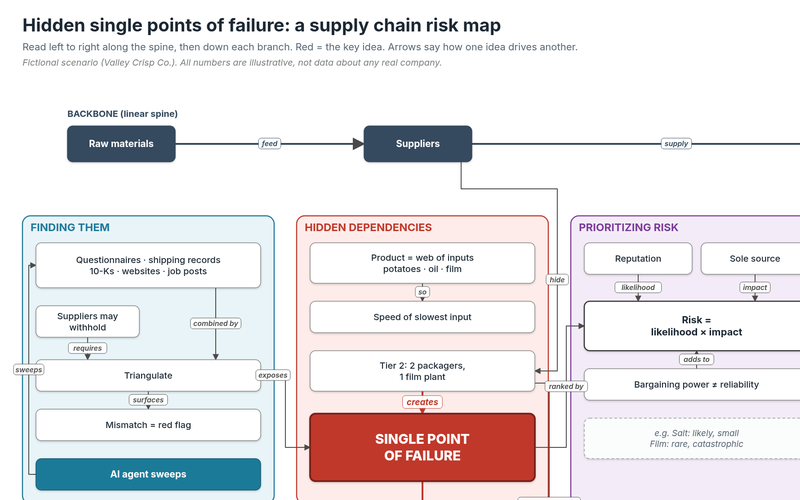
Detail of a supply chain risk map: two packaging suppliers both depend on one film plant, a hidden tier-2 single point of failure

Case study

Two Suppliers, One Factory

A snack company thinks it has two packaging suppliers. Both rely on the same film plant one tier down, so it really has one. The study shows how to find that kind of hidden dependency, rank it, and set controls that buy time.

Fictional company; all numbers are illustrative.
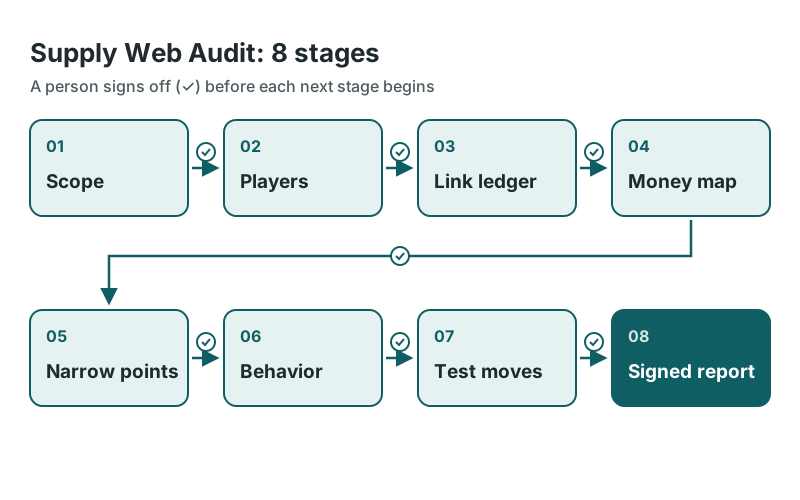
Diagram of the eight audit stages: scope, players, link ledger, money map, narrow points, behavior, test moves, signed report, with a sign-off check between each

Framework

Supply Web Audit

An 8-stage method for auditing a business's supply web, from scope to a signed risk report. A person or an AI agent can run it, and a person signs off before each stage moves on. Every claim is labeled as established, assumed, or a gap.

A method, not yet tested on a real client. The included walkthrough uses a fictional company.

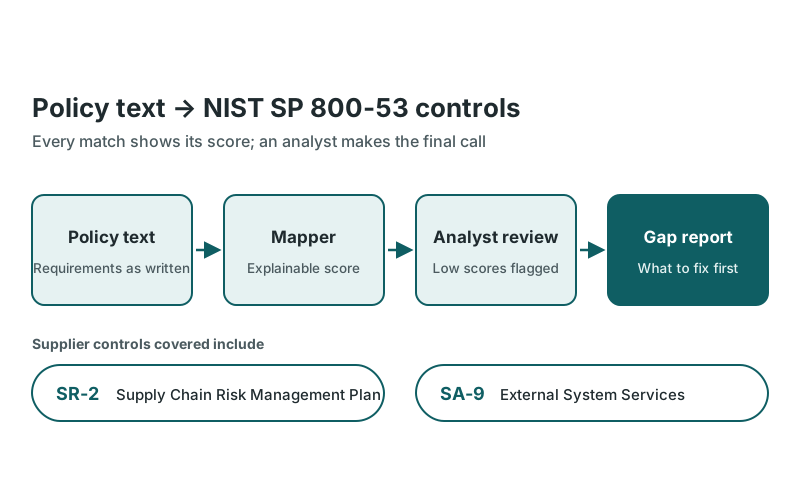
Flow from policy text to mapper to analyst review to gap report, with supplier controls SR-2 and SA-9 highlighted

Tool

GRC Control Mapper

Reads a security policy and maps each requirement to NIST SP 800-53 controls, including the supplier controls SR-2 and SA-9. Each match shows why it scored the way it did, and weak matches go to an analyst review queue instead of being trusted blindly.

64 automated tests.

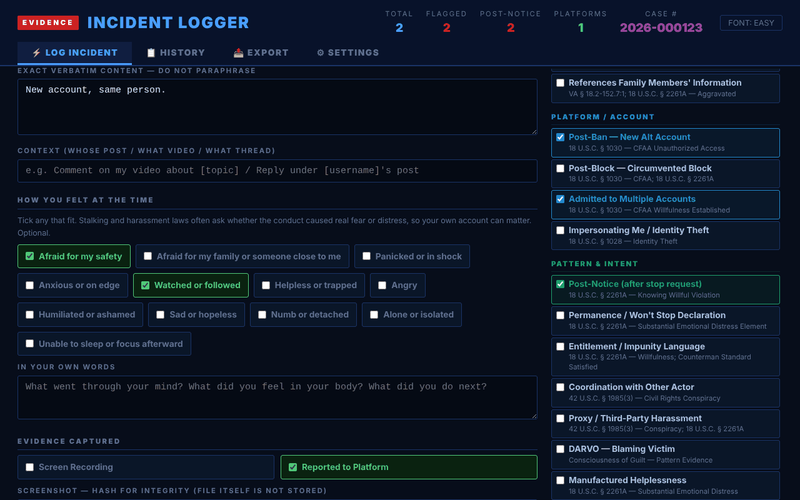
Screenshot of the Incident Logger form, with fields for what happened, how the person felt, and evidence captured

Tool

VA Incident Mapper

Helps someone document a cyber incident and produce reports they can hand to police or an attorney. Evidence is logged with SHA-256 hashes, so any later change to a record can be detected.

51 automated tests. Not legal advice.

Risk assessment

AI Supply Chain Risk Assessment

Nine scored AI-related supply chain risks, with controls, warning indicators (KRIs) and a 30/60/90-day plan.

Playbook

AI-Assisted Risk Analysis

A reusable risk-analysis prompt and a worked example where an AI first draft is checked and corrected by a human reviewer.

Framework

Reading the Room: Power and Behavior Risk Indicators

Observable signs of how power, incentives and group behavior shape risk decisions, and how to turn them into solid findings.

Framework

Behavioral Supply Chain Risk: Human Factors, AI, and Audit

How bias and pressure create supply chain risk, and how AI triage, audit evidence and human review help catch it.

Strategy

Playing the Risk Game: Game Theory for Supply Chain Risk and AI Governance

Plain-language game theory that explains why supply chain and AI risks persist, and which incentives to change.

Field guide

AI in Supply Chain Operations: A Strategist's Field Guide

How a supply chain manager can use AI in six everyday jobs, and what to check before trusting it.

Case study

Healthcare Cyber Risk Program: An OSINT Case Study

A cyber risk program for a fictional regional health system, built only from public sources.

Field guide

AI for CISA and IT Auditors: Creative Workflow Accelerators

Nine practical ways AI can speed up IT audit work, from walkthroughs and SOC 2 review to auditing AI, with a human check at every step.

Field guide

Localized Small Supply Chain: AI Prompts and Workflows

Nineteen copy-and-paste AI prompts and short workflows for small local businesses: suppliers, ordering, forecasting, overstock and dead stock, vendor lead times, and supply risk. Works with any AI chat tool, with a human check at every step.

Tool

Engineering Prompts: Human-in-the-Loop AI Prompts for Engineers

23 model-agnostic prompts for software and ICS/OT engineers, each with human gates at the start, middle and end.

Writing

AI Risk Lives in the Permissions (PDF, 3 pages)

Treat unapproved AI tools the way you would an unvetted vendor, with a 30/60/90-day plan to inventory them, tighten their permissions, and add checks before their output reaches anyone. All sources checked.

How I work

  1. Talk it through and map it

    Start with the people who know the work, then draw who depends on whom.

  2. Break it into connected concepts

    Split the problem into small ideas and show how each one drives the next.

  3. Automate the repeatable parts

    Turn the steps that repeat into tools or AI agent workflows, with a person checking the result.

Background

Contact